
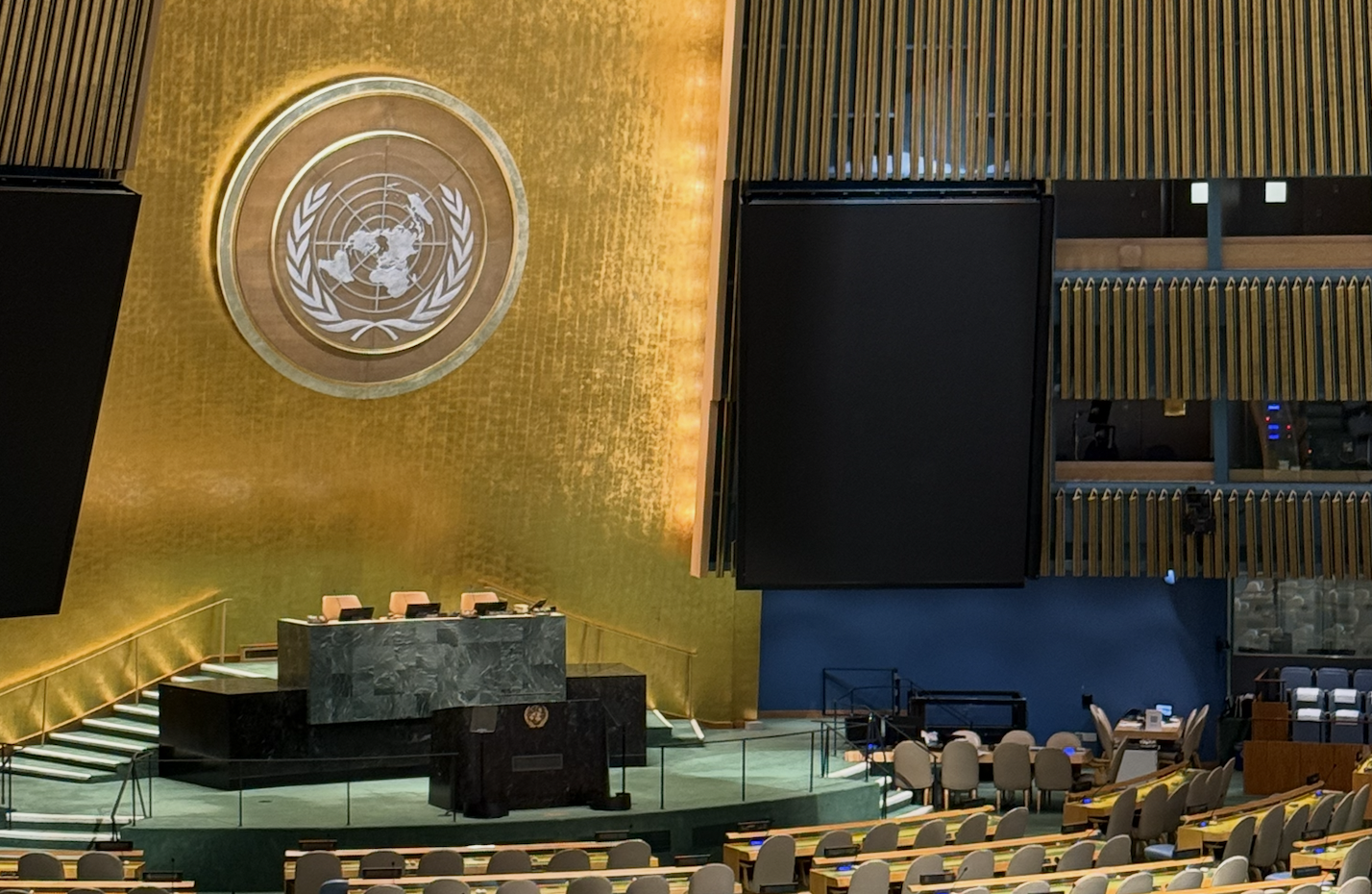
The UNGA 81 education debate did not take place in a single meeting or under one headline. It appeared throughout the General Debate in discussions about debt, artificial intelligence, human rights, economic development, migration, employment and the future of national sovereignty. That matters.
The 81st session of the United Nations General Assembly is taking place under the theme “Restoring Trust, Managing Transformation: A United Nations That Delivers for All.” During the General Debate in New York from 22 to 28 September 2026, heads of state and government approached education from very different national circumstances. Yet several recurring ideas emerged: countries need the fiscal capacity to finance education; access must lead to actual learning; teachers need support as AI enters classrooms; young people need skills that translate into opportunity; and education remains inseparable from human rights. United Nations
These statements do not constitute a formal UN consensus on education. They do, however, reveal how political leaders are increasingly positioning education inside much larger questions about the future of their economies and societies.
For ICARUS, that shift is significant because it moves education closer to where it belongs: as part of the infrastructure through which societies develop human capability.
Education sits directly between trust and transformation.
Kenya and the DRC: first access, then quality
Kenyan President William Samoei Ruto placed education directly inside the international debate over development finance.
He described additional investment in teachers, classrooms, laboratories, universities and technical institutions before making a simple distinction:
“Education is not consumption.” UN Transcript — President William Samoei Ruto, Kenya
Ruto’s broader argument was that expensive borrowing and debt servicing can constrain the ability of developing countries to invest in their own people. In this framing, education becomes productive national infrastructure rather than simply another social expenditure. The UN transcript records Kenya reporting an additional $5.3 billion in education expenditure over four years, 100,000 additional teachers and more than 23,000 new classrooms. UN Transcripts
Prime Minister Judith Suminwa Tuluka of the Democratic Republic of the Congo approached the issue from another point in the education journey. She said free primary education had enabled more than five million additional children to attend school since 2019. Primary enrolment exceeded 21 million in 2023–24, compared with 14.7 million four years earlier. UN Transcripts
Then came the harder part:
“Access is not enough.” UN Transcript — Prime Minister Judith Suminwa Tuluka, DRC
That distinction reaches well beyond the DRC. A place in a classroom establishes access. So does a login to a digital platform. Neither guarantees understanding, participation or competence.
Estonia and Bangladesh: the AI divide is becoming an education divide
Estonian President Alar Karis brought artificial intelligence directly into education.
Speaking about Estonia’s approach to AI in schools, his principle was that technology should:
“empower teaching and learning rather than replace them.” UN Transcript — President Alar Karis, Estonia
The sentence matters because much of the education debate around AI still begins with the capabilities of the technology. Karis placed the emphasis elsewhere: on what technology allows teachers and students to do. UN Transcripts
Bangladesh approached the same transformation through inequality. Prime Minister Tarique Rahman said his government plans to raise education expenditure to 5% of GDP within five years, alongside greater emphasis on technical, practical and employment-oriented education. He also warned that the digital divide should not evolve into an artificial-intelligence divide. UN Transcripts
That is a more complicated divide than the one created by connectivity.
Two students can have access to exactly the same AI system and possess very different levels of agency. One understands how to question an output, verify evidence and recognize uncertainty. Another may simply accept whatever the system generates.
Equal access to AI does not automatically produce equal capability. UN Transcript — Prime Minister Tarique Rahman, Bangladesh
Montenegro and Burundi: what happens to talent after education?
President Jakov Milatović of Montenegro spoke about education as a means of expanding the possibilities available to young people.
Education, he said, is
“our most powerful investment in young people.” UN Transcript — President Jakov Milatović, Montenegro
Milatović connected this to his own experience of studying and working abroad before returning home. His argument broadened education beyond qualifications: it should equip young people with knowledge, critical thinking and the ability to shape their societies. UN Transcripts
Burundi’s President Évariste Ndayishimiye, also speaking as Chairperson of the African Union, raised what happens after countries make that investment.
He argued that African states devote substantial resources to education, vocational training, entrepreneurship, science and technology, while skilled graduates can subsequently be attracted to economies offering significantly greater material opportunities. His call was for fairer partnerships around the value created by investment in human capital. UN Transcripts
UN Transcript — President Évariste Ndayishimiye, Burundi
The policy question is delicate. Mobility can create knowledge exchange, remittances and international networks. But education policy cannot end at graduation. Countries also need environments in which educated people can research, create businesses, build institutions and see a credible future.
Liberia and Nigeria: from technology consumption to capability
Liberian President Joseph Nyuma Boakai connected education directly with digital sovereignty.
With Africa’s young population in mind, he called for greater STEM education, digital literacy and technical training so that young people become:
“co-creators … not just consumers.” UN Transcript — President Joseph Nyuma Boakai, Liberia
Boakai also argued that developing nations should not remain dependent on algorithms designed elsewhere without the capacity to participate in creating and governing the technologies shaping their economies. UN Transcripts
This is an important evolution of the digital-divide debate. Connectivity gave people entry into the digital world. Education must now give them the capability to shape it.
Nigeria’s statement, delivered by Vice President Kashim Shettima, linked technological transformation with another familiar constraint: finance. He argued that many developing economies devote significant resources to servicing debt “at the expense of education”, healthcare and infrastructure. UN Transcripts
UN Transcript — Vice President Kashim Shettima, Nigeria
The parallel with Kenya is striking without implying identical national circumstances. Education ambition ultimately depends on the fiscal capacity to recruit people, build institutions and sustain infrastructure.
Barbados and Ireland: knowledge, action and the right to learn
Prime Minister Mia Amor Mottley of Barbados described a different failure: the distance between knowledge and execution.
Much of the world already knows what needs to change, she argued. The recurring difficulty is our inability to “convert what we know into what we do.” UN Transcripts
UN Transcript — Prime Minister Mia Amor Mottley, Barbados
Education illustrates that gap particularly well.
We know that teachers matter. poverty and conflict interrupt learning, language can become a barrier, that putting material online does not necessarily make it usable. Increasingly, we also understand that introducing AI without developing human judgment creates its own vulnerabilities.
Ireland’s Taoiseach Micheál Martin returned the debate to an even more fundamental level when discussing Afghanistan:
“Girls are being denied the education” that should help shape their futures. UN Transcripts
UN Transcript — Taoiseach Micheál Martin, Ireland
That places every conversation about AI, personalization and future skills into perspective. Before education can be technologically advanced, the right to learn must exist.
What UNGA 81 reveals about education
These national statements do not amount to a single UN position on education. The countries involved have different economies, institutions and political priorities.
Taken together, however, their speeches show how widely education now reaches across public policy.
Kenya and Nigeria connected it to international finance. The DRC focused on the movement from access toward quality. Estonia and Bangladesh examined education in the age of AI. Montenegro and Burundi raised questions about youth opportunity and human capital. Liberia connected education to technological participation and sovereignty. Ireland returned to fundamental rights. Barbados focused on the distance between knowledge and implementation.
The global data give those conversations scale.
UNESCO’s 2026 Global Education Monitoring Report estimates that 273 million children and young people are out of school, with the number rising for a seventh consecutive year. UNESCO also estimates that 44 million additional teachers are required to achieve universal primary and secondary education by 2030. UNESCO
At the other end of the education pathway, the ILO reports that more than 257 million young people are outside employment, education or training. International Labour Organization
The challenge runs across the entire chain: access, learning, teaching, capability and opportunity.
The ICARUS response: access must become usable access
At ICARUS, we begin with a distinction that increasingly matters: the existence of educational content is not the same as meaningful access to education.
A lecture can be online and remain difficult to search. A library can contain enormous value while making the right knowledge difficult to locate. A learner may technically have access to material that remains inaccessible because of language.
UNESCO’s SDG 4 Knowledge Hub has published the ICARUS practice “AI-enabled multilingual learning infrastructure for inclusive lifelong learning.” UNESCO describes the practice as using AI-enabled search, transcription, translation and content indexing to make digital learning resources easier to access, reuse and adapt for lifelong learning and professional upskilling. UNESCO
This is where the DRC’s formulation becomes especially relevant.
Access is essential. But the next measure is whether access becomes understanding.
For ICARUS, multilingual learning, searchable knowledge, intelligent discovery and competence-oriented pathways are ways of reducing the distance between information being available and a learner being able to use it.
From AI access to AI agency
The second response concerns artificial intelligence.
At the United Nations Global Dialogue on AI Governance in Geneva in July 2026, the ICARUS-led side event AI for Every Mind: Education, Human Agency & Governance focused on a movement from AI access to AI agency.
Access means being able to operate an AI system.
Agency requires something deeper: enough knowledge and judgment to question its output, verify information, identify limitations and remain accountable for decisions made with it.
The side-event report argued that education should therefore be treated as part of the infrastructure of AI governance itself. ICARUS Education
That position intersects directly with several UNGA 81 interventions. Estonia emphasized AI that strengthens teaching. Bangladesh raised the risk of an AI divide. Liberia argued for young people to become creators rather than passive consumers of digital technology.
These are different national arguments, but they point toward a common educational problem: access to increasingly powerful systems is moving faster than the development of the human capability required to use them well.
Teachers remain part of the infrastructure
The global deficit of 44 million teachers can make technological scale particularly attractive. But a shortage of teachers is not, by itself, evidence that education should be designed around their absence.
It is an argument for using technology to increase their capacity.
AI can make long-form educational material searchable. It can help translate content, organize institutional knowledge and reduce time spent locating resources. Used carefully, it can support more flexible and multilingual learning.
The educator contributes something different: context, interpretation, mentorship, trust and accountability.
UNESCO itself stresses that trained and supported teachers remain essential to quality education, even as education systems integrate new digital technologies. UNESCO
The more useful question is therefore not how many educators technology can replace.
It is how much capacity responsible technology can return to them.
Nektar Baziotis: human infrastructure must keep pace
My own conclusion from these UNGA 81 interventions is that the world needs to think more seriously about human infrastructure.
We are investing extraordinary resources in computational infrastructure, AI models, data centres and digital platforms. Those investments will transform economies and institutions.
Human capability needs to advance with equal seriousness. I have previously described
“Education [as] the primary infrastructure of human rights.” ICARUS Education
Education affects whether people can understand the systems influencing their lives, distinguish information from evidence, participate economically, exercise their rights and retain meaningful judgment when automated technologies become part of everyday decision-making.
A society can purchase technology. The accumulated knowledge, judgment and agency of its people must be developed. That is why education cannot sit downstream from technological transformation. It has to develop alongside it.
The question after UNGA 81
At the close of the General Debate, the President of the General Assembly noted that artificial intelligence had moved dramatically toward the centre of UN discussion: 128 delegations addressed AI during the week, compared with only five four years earlier. United Nations
That makes the education question even more urgent. The next decade will give societies access to more information and computational power than any previous generation possessed. That does not automatically create wiser institutions, stronger communities or more capable citizens.
UNGA 81 did not produce a common blueprint for education.
It revealed something different. Education now appears wherever the future is being negotiated: in debates about debt, AI, employment, sovereignty, human rights and opportunity.
The world will continue to build more capable machines. Our responsibility is to ensure that we are also building more capable human beings. Education is where that work begins.
UN Speeches and Sources
- United Nations — 81st Session of the UN General Assembly — official session, theme and dates. Official UNGA 81 page
- United Nations — General Debate of the 81st Session — official General Debate dates and venue. Official General Debate page
- United Nations — Day 2 General Debate Transcript Official UN-hosted searchable transcript containing the speeches of Burundi, Estonia, Kenya, Montenegro and the Democratic Republic of the Congo. UN Transcript — Day 2
- United Nations — Day 3 General Debate Transcript Official UN-hosted searchable transcript containing the speeches of Liberia, Nigeria, Barbados, Bangladesh and Ireland. UN Transcript — Day 3
- United Nations General Assembly — Close of the General Debate, 28 September 2026 Official summary and participation figures for UNGA 81. UNGA 81 Closing Remarks
- UNESCO — 2026 Global Education Monitoring Report: Access and Equity Source for the estimate of 273 million children and youth out of school. UNESCO 2026 GEM Report
- UNESCO — Teachers Source for the estimate that 44 million additional teachers are required by 2030. UNESCO Teachers
- International Labour Organization — Global Employment Trends for Youth 2026 Source for youth unemployment and the more than 257 million young people outside employment, education or training. ILO — Global Employment Trends for Youth 2026
- UNESCO SDG 4 Knowledge Hub — AI-Enabled Multilingual Learning Infrastructure for Inclusive Lifelong Learning Official UNESCO publication of the ICARUS good practice. UNESCO SDG 4 Knowledge Hub — ICARUS
- ICARUS — Global Dialogue on AI Governance Side Event Report Source for the ICARUS position on education, AI agency and human capability. ICARUS — AI for Every Mind
- ICARUS — AI Governance, Human Rights and the New Human Contract Source for Nektar Baziotis’s position on education as human-rights infrastructure. ICARUS — Nektar Baziotis on AI Governance and Human Rights