

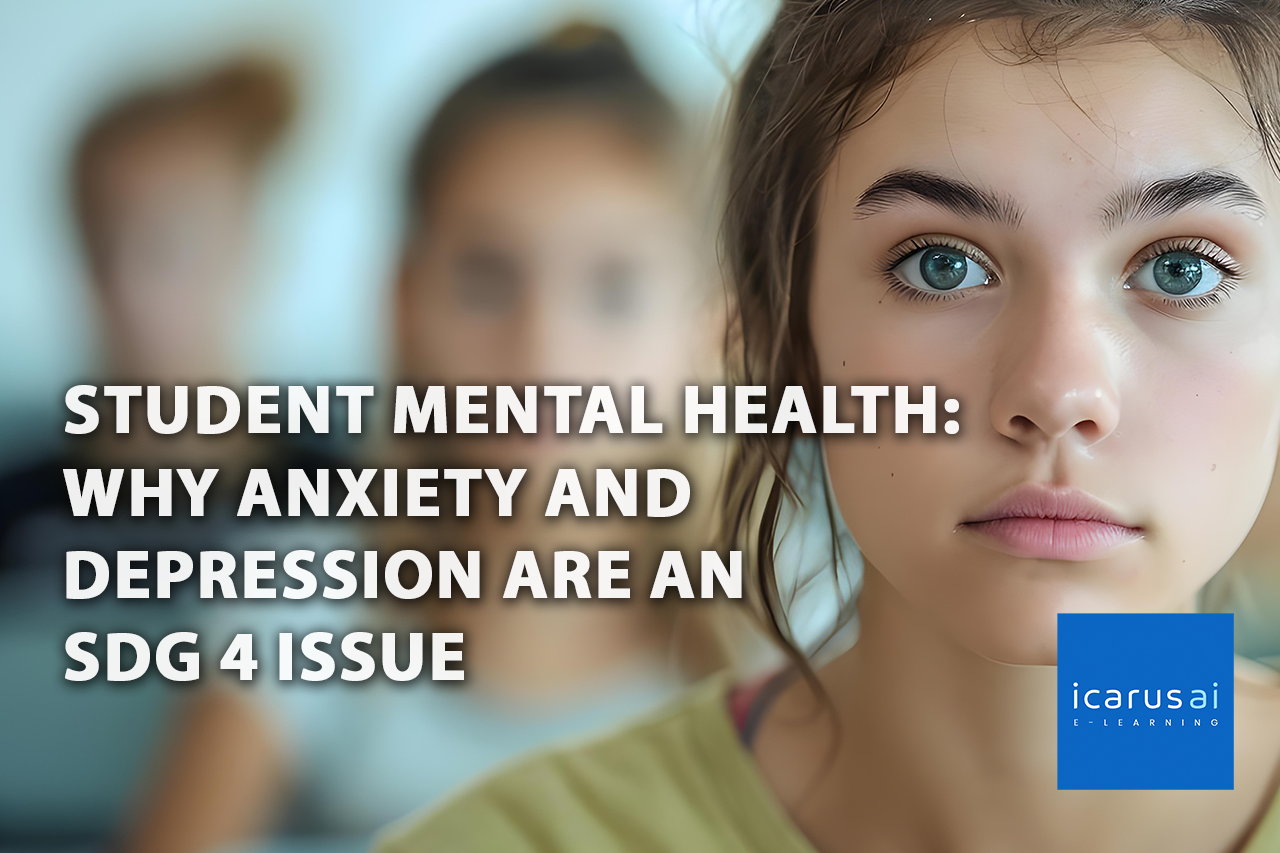
Anxiety and depression are usually discussed as health conditions. In schools and universities, however, they are also education conditions. When a student cannot attend regularly, concentrate, participate, complete assignments or imagine a future worth working toward, mental health becomes inseparable from learning.
That is why the growing mental-health burden among young people deserves to be treated as part of the global education agenda. The World Health Organization estimates that one in seven adolescents aged 10–19 experiences a mental-health condition, while anxiety and depressive disorders can have a profound effect on school attendance and schoolwork. UNESCO makes the same connection from the education side, emphasizing that emotional distress, anxiety and poor mental health can directly affect well-being, learning and future opportunity.
For ICARUS, the implication is clear. Quality education cannot be measured only by whether a student has access to a classroom, a teacher or a digital platform. It must also consider whether that student is actually able to participate, learn and persist.
When attendance becomes a mental-health signal
Absence from school is often treated as an administrative problem, and sometimes it is. But repeated absence can also be a warning sign. A student experiencing severe anxiety may begin avoiding the classroom because social interaction, performance expectations or fear of failure have become overwhelming. Depression can reduce energy, motivation and the ability to complete even routine tasks.
In those cases, attendance should not be interpreted only through the language of discipline or disengagement. It may reflect a student who is struggling to remain connected to education at all. WHO explicitly notes that anxiety and depressive disorders can affect school attendance and schoolwork, while young people experiencing mental-health conditions are also more vulnerable to educational difficulties, social exclusion and stigma.
This should change the questions schools and universities ask. Instead of focusing only on why a student is absent, institutions should also ask what is preventing that student from participating. That is a more human question, and it is also a more useful one.
Mental health affects learning before absence begins
The impact of anxiety and depression often appears before a student ever stops attending. A learner may be physically present and still struggle to engage. Anxiety can consume attention, while depression can reduce motivation, weaken concentration and create the sense that effort will not lead anywhere. Persistent emotional distress can also affect sleep, memory, relationships and confidence.
This matters because education systems traditionally measure visible outcomes such as attendance, grades, completion and progression. Mental-health difficulties often emerge earlier, in the spaces between those indicators. A student may stop asking questions, begin submitting work late, withdraw socially or lose interest in subjects that previously mattered to them. By the time a clear decline appears in formal metrics, the underlying problem may already have become serious.
The educational challenge is therefore not only to react to failure, but to recognize changes in participation early enough to support the learner before temporary difficulty becomes permanent disengagement.
The scale of the challenge
The scale of the issue justifies much greater urgency. WHO estimates that around 14% of adolescents globally experience a mental-health condition. Anxiety disorders are among the most common, and depression remains a major concern across adolescence and young adulthood. Anxiety disorders are also the most common mental disorders globally, affecting hundreds of millions of people.
Yet access to effective support remains limited. Many young people never receive appropriate help, and stigma, cost, availability of services and lack of awareness can all delay care. For students, this gap becomes an education problem as well as a health problem because emotional distress follows them into the classroom, the lecture hall and the digital learning environment.
A school cannot assume that academic support alone will solve a mental-health difficulty. A university cannot treat repeated disengagement simply as lack of motivation. And a digital education system cannot assume that giving a learner more content will help when the learner is already cognitively and emotionally overwhelmed.
Why this belongs inside SDG 4
Sustainable Development Goal 4 calls for inclusive and equitable quality education and lifelong learning opportunities for all. The word “inclusive” matters. Educational inclusion is incomplete when a student technically has access to learning but cannot meaningfully participate because anxiety, depression or psychological distress has made that access unusable.
The word “quality” matters just as much. Quality education should include the conditions under which learning can actually happen. This does not mean turning schools into hospitals or asking teachers to become therapists. It means recognizing that mental health and education are deeply interdependent.
WHO’s guidance for the education sector recommends safer and more inclusive learning environments, stronger mental-health literacy, appropriate psychosocial support and better links between education and health services. This is a system-level response, and it is where education policy increasingly needs to move.
Schools and universities can become protective environments
Education institutions are not only places where mental-health difficulties become visible. They can also become protective environments. UNESCO has emphasized that safe, inclusive and caring schools can strengthen resilience and support learners’ well-being.
That protective role can take many forms. Educators who understand warning signs can help students access support earlier. Institutions with clear referral pathways can connect learners to qualified professionals. Curricula that include social and emotional learning can strengthen coping, communication and problem-solving skills. A culture in which asking for help does not carry stigma can make early intervention more likely.
These actions do not replace clinical care. They improve the chances that students receive the right help before a difficult period becomes a crisis. They also send an important message: mental health belongs inside the conversation about student success.
Mental health should be part of student success infrastructure
Many institutions still approach mental health through awareness days, occasional workshops or optional well-being resources. Those efforts can help, but they are not enough if mental health is already affecting attendance, concentration, retention and completion.
Education systems should therefore treat mental health as part of student success infrastructure. That means monitoring patterns of absence, withdrawal and sudden academic decline more intelligently, while respecting privacy and avoiding inappropriate surveillance. It means training educators to recognize concerns without asking them to diagnose students. It also means creating clear connections between teaching staff, counselling services, health professionals and families where appropriate.
Institutions should also examine whether their own practices contribute to unnecessary stress. Assessment design, communication, workload, financial pressure and rigid attendance structures can all affect student well-being. Supporting mental health therefore requires more than offering a counselling phone number. It requires looking at the learning environment itself.
The economic argument is also strong
There is also an economic reason governments and education institutions should invest early. WHO has estimated that every dollar invested in adolescent mental health can generate significant long-term returns through improved health, education and economic participation.
That matters because education and mental health reinforce each other over time. A student who remains engaged in education is more likely to complete qualifications, participate in employment and contribute economically. By contrast, untreated mental-health difficulties can reduce educational attainment, employment prospects and long-term well-being.
Investment in student mental health should therefore be understood as human-capital infrastructure. It supports individual well-being, but it also strengthens education systems, labour markets and social resilience.
Technology can support continuity, but it cannot replace care
Digital technology can help make learning more resilient around students who are struggling. It can support flexible participation, asynchronous access, multilingual learning and easier navigation of educational content. It can help students remain connected when they temporarily cannot participate in a conventional schedule.
At the same time, technology must be used carefully. AI should never be presented as a substitute for qualified mental-health professionals, and automated systems should not diagnose students without appropriate clinical governance. Institutions must also handle behavioural and educational data with great care, particularly when using patterns of disengagement as possible indicators of distress.
The right role for technology is supportive. It can make education more flexible and information easier to access. It can help educators find relevant resources and help students maintain continuity during difficult periods. Human care, professional judgment and trusted relationships must remain central.
What ICARUS can contribute
At ICARUS, we believe the education response should focus on continuity, accessibility and learner capability. A student facing anxiety or depression may need to revisit material asynchronously, navigate long-form content more efficiently, use learning resources in their strongest language or continue progressing at a pace that reflects the reality of their circumstances.
These are areas where intelligent learning infrastructure can help. The objective is not to treat anxiety or depression. The objective is to make education more resilient around the learner.
That distinction matters. Mental-health education can help people recognize when support may be needed, while qualified professionals provide treatment and care. Educational technology can reduce unnecessary friction and help preserve learning continuity. When those roles remain clear, technology can contribute meaningfully without overstepping.
From student well-being to educational resilience
This is where the issue becomes larger than individual mental health. An education system is resilient when it can keep learners connected even when life becomes difficult.
That may involve counselling and mental-health support. It may involve flexible scheduling, digital continuity, multilingual resources or stronger relationships between students, educators and families. The common principle is that difficulty should not automatically become exclusion.
This is particularly important for students already facing disadvantage, displacement, poverty, disability, discrimination or unstable living conditions, because mental-health risks can compound existing barriers. An inclusive education system must be capable of responding to that complexity rather than expecting every learner to follow the same path at the same pace.
The next measure of quality education
For too long, access was measured by whether a seat existed. Then digital access was measured by whether a login existed. The next step is more demanding.
Can the learner actually participate? Can they stay connected when they struggle? Can institutions recognize distress early enough to respond? Can education systems protect learning without sacrificing mental well-being?
These questions belong at the heart of SDG 4 because a student who is present but unable to learn is not fully included. A student who disappears from education because anxiety or depression went unnoticed represents more than an individual difficulty. It also reveals a weakness in the system around them.
At ICARUS, we believe the future of quality education must take this seriously. Mental health does not sit outside learning. It shapes whether learning is possible.
Sources:
- World Health Organization — Mental Health of Adolescents – https://www.who.int/news-room/fact-sheets/detail/adolescent-mental-health
- WHO — Guidance on Policy and Strategic Actions for Mental Health and the Education Sector – https://www.who.int/publications/b/80913
- UNESCO — What You Need to Know About Mental Health and Psychosocial Support in Schools– https://www.unesco.org/en/health-education/mental-health
- WHO — Children and Young People’s Mental Health: The Case for Action – https://www.who.int/news-room/commentaries/detail/children-and-young-people-s-mental-health–the-case-for-action
- WHO — Anxiety Disorders – https://www.who.int/news-room/fact-sheets/detail/anxiety-disorders
- UNICEF — Global Annual Results Report 2025: Mental Health – https://www.unicef.org/reports/global-annual-results-2025-mental-health