
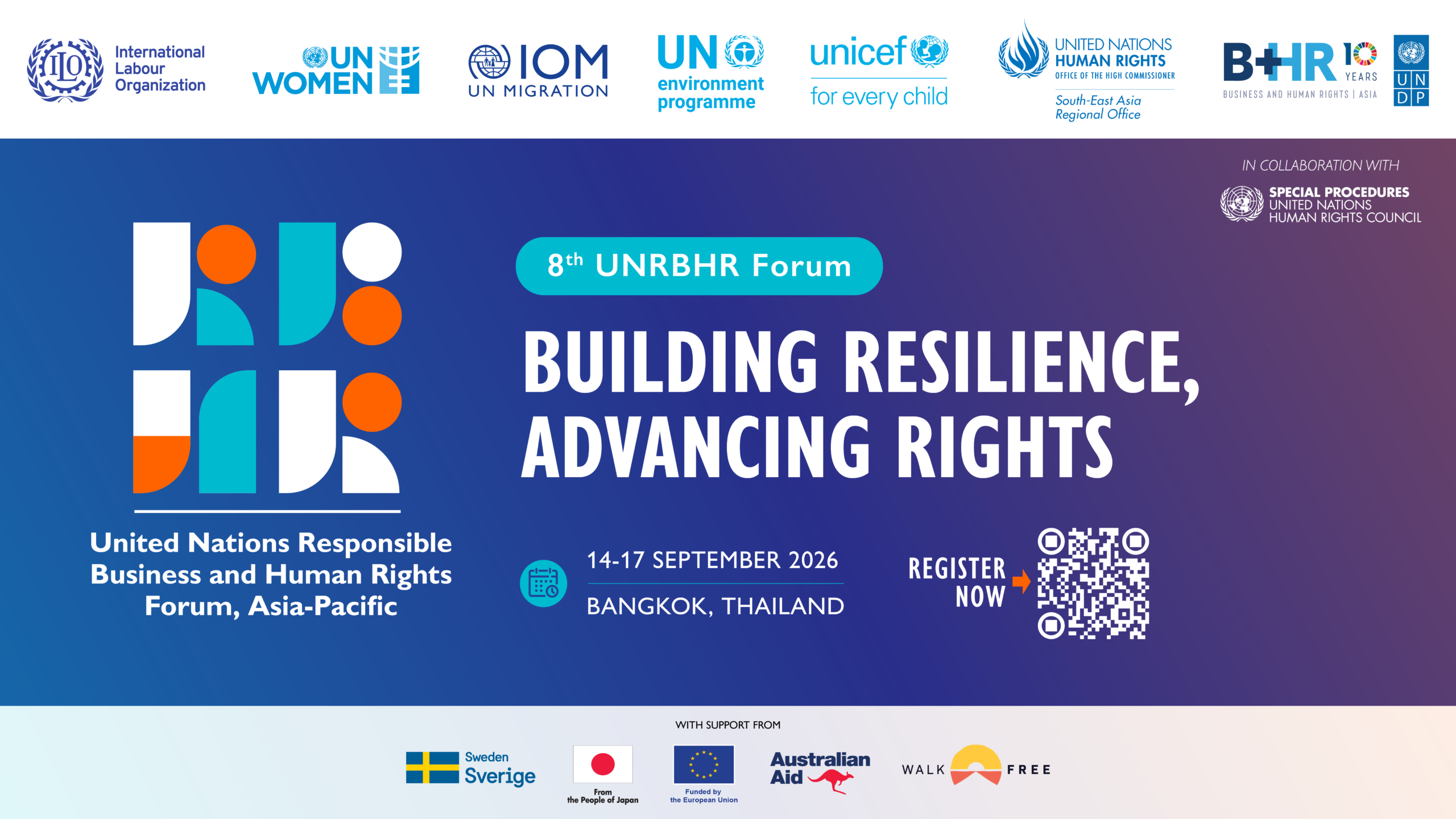
8TH UNRBHR FORUM · 14–17 SEPTEMBER 2026 – BANGKOK, THAILAND
Artificial intelligence is already changing the workplace.
It is influencing how organizations recruit, train, monitor, evaluate and support people. It is also reshaping productivity, management, decision-making and the skills that workers need to remain relevant in a changing economy.
However, responsible AI at work is not only a technology issue. It is a human rights issue.
That is the central message behind the session “Beyond the Headlines: What AI Really Means for the World of Work”, bringing together ICARUS AI Inc. and Ius Laboris at the UN Responsible Business and Human Rights Forum in Bangkok.
Why Responsible AI at Work Matters
Many organizations are adopting AI quickly. They are testing new systems, automating workflows and using intelligent tools to support decisions that affect people’s lives.
At the same time, many workers and managers are not being prepared at the same speed.
This creates a serious gap. On one side, AI systems are becoming more powerful. On the other side, the people expected to use, question or oversee those systems may not have the knowledge, confidence or authority to do so.
That gap is where human rights risks can emerge.
AI can affect fairness, privacy, worker dignity, discrimination, transparency, access to opportunity and the right to challenge decisions. Therefore, organizations cannot treat AI adoption as a purely technical transformation. They must treat it as a people, governance and rights challenge.
From Policy to Practice
Ius Laboris brings a critical workplace law and employer practice perspective to this discussion. Across the Asia-Pacific region and globally, employers are trying to understand how AI affects recruitment, performance management, workforce planning, compliance and risk.
Policies matter. Legal frameworks matter. Governance structures matter.
But policies alone are not enough.
Responsible AI at work becomes real only when people inside organizations understand what those policies mean in daily decisions. A policy cannot protect workers if managers do not know when to question an AI recommendation. A compliance document cannot create trust if workers do not understand how a system affects them. A governance framework cannot work if no one has the authority to pause, escalate or challenge a harmful decision.
This is where the discussion must move from policy to practice.

The ICARUS AI Perspective: Human Rights Capability
ICARUS AI brings the perspective of human capability, education and workforce readiness.
Our contribution is based on a simple principle: digital training is not enough.
Workers, managers and leaders do not need only awareness of AI. They need real human rights capability.
Human rights capability means the practical ability to recognize risks, ask the right questions and act responsibly when AI affects people. It means understanding when AI may create discrimination, exclusion, surveillance, lack of transparency or unfair treatment. It also means knowing how to respond when something goes wrong.
This requires more than a one-off training session.
It requires continuous, role-based learning. Workers need to understand how AI affects their tasks, data and rights. Managers need to know when to rely on AI, when to challenge it and when to escalate concerns. HR teams need to understand bias, explainability and remedy. Leaders need to understand accountability and long-term workforce impact.
In other words, responsible AI at work depends on capable humans.
The Human in the Loop Must Be Real
One of the most common phrases in AI governance is “human in the loop.”
The phrase sounds reassuring. Yet it can also hide a deeper problem. Who is the human in the loop?
Is it a manager approving an AI-supported decision? An HR professional using an automated screening tool? A worker being evaluated by a system they do not understand? A legal or compliance team reviewing risks after deployment?
More importantly, does that human have real authority?
If a person cannot understand the system, question its output, escalate a concern or override a decision, then they are not truly in the loop. They are only near the loop. In some cases, they may carry responsibility without power.
Responsible AI at work requires meaningful human oversight. That means knowledge, judgment, clear roles and institutional support. It also means giving people the right to challenge systems that affect their work, dignity and opportunity.
The Next Workplace Divide
The next workplace divide will not only be digital. It will be a capability divide.
Some organizations will use AI to strengthen people, improve decisions and build more resilient workplaces. Others may use AI mainly to accelerate processes without preparing the workforce for the consequences.
The difference will not be the tool alone. It will be the capability around the tool.
Organizations that succeed will be those that invest in people alongside technology. They will build trust through transparency. Include workers in the conversation. Make AI literacy practical. Ensure that responsible AI is not only discussed by legal, technical or executive teams, but understood across the workplace.
This is essential for the future of work.
Building Responsible and Resilient Workforces
Responsible AI can create value. It can improve access to learning, support better decision-making, help organizations identify skills gaps and make work more efficient.
However, these benefits are not automatic.
They depend on how AI is introduced, governed and understood. They also depend on whether workers are treated as passive users or active participants. A resilient workforce is not one that simply adapts to technology. It is one that can understand change, question it and shape it responsibly.
That is why education and capability-building must be part of every responsible AI strategy. Organizations should not ask only whether the AI system is ready. They should also ask whether their people are ready.
A Practical Message for Employers
For employers, the message is clear.
Responsible AI at work should begin with people.
Before introducing AI systems, organizations should ask who:
- will be affected by this tool?
- understands how it works?
- can explain its limits?
- can challenge its outputs?
- has the authority to pause or override a decision?
These questions help move AI governance from theory into practice.
They also help organizations build trust. Workers are more likely to accept AI when they understand its purpose, when they know their rights and when they are included in meaningful dialogue.
Conclusion: Beyond the Headlines
AI will continue to transform the world of work.
The real question is whether organizations will treat that transformation as a race for efficiency or as an opportunity to build more responsible, inclusive and resilient workplaces.
The partnership between ICARUS AI and Ius Laboris brings together two essential perspectives: workplace law and human capability. Together, they point toward a practical truth.
Responsible AI at work requires more than tools. It requires clear rights, meaningful oversight, continuous learning and people who are prepared to act.
The future of work will not be shaped by AI alone. It will be shaped by the people who are ready to govern it.
Sources:
- 8TH UNRBHR FORUM · 14–17 SEPTEMBER 2026 — https://www.rbhrforum.com/
- UN Guiding Principles on Business and Human Rights — https://www.ohchr.org/documents/publications/guidingprinciplesbusinesshr_en.pdf
- OECD AI Principles — https://www.oecd.org/en/topics/ai-principles.html
- OECD Employment Outlook 2023: Ensuring Trustworthy Artificial Intelligence in the Workplace — https://www.oecd.org/en/publications/oecd-employment-outlook-2023_08785bba-en/full-report/ensuring-trustworthy-artificial-intelligence-in-the-workplace-countries-policy-action_c01b9e49.html
- ILO: Artificial Intelligence and the World of Work — https://www.ilo.org/topics-and-sectors/artificial-intelligence
- ILO: Algorithmic Management in the Workplace — https://www.ilo.org/algorithmic-management-workplace
- ILO: Global Case Studies of Social Dialogue on AI and Algorithmic Management — https://www.ilo.org/publications/global-case-studies-social-dialogue-ai-and-algorithmic-management
- EU AI Act Service Desk: Employment, Workers Management and Access to Self-Employment — https://ai-act-service-desk.ec.europa.eu/en/employment-0
- EU AI Act Recital 57: Employment and Workers’ Rights — https://ai-act-service-desk.ec.europa.eu/en/ai-act/recital-57
- OECD / ILO: Compendium of Best Practices for Human-Centered AI in the World of Work — https://www.oecd.org/en/publications/compendium-of-best-practices-for-a-human-centered-development-and-use-of-artificial-intelligence-in-the-world-of-work_inmx2843.html
- ILO / OECD: Compendium of Best Practices for Human-Centered AI in the World of Work — https://www.ilo.org/publications/compendium-best-practices-human-centered-development-and-use-artificial