
A practical ICARUS perspective on which AI tools create real value for teams, creators, and learning ecosystems
The AI conversation has become noisy.
Every week brings another launch, another list of “must-have” tools, another promise that productivity is about to change forever. For teams trying to work seriously, however, the real problem is selection.
The question is which ones actually improve how people think, collaborate, create, and learn.
At ICARUS, we believe this distinction matters more than ever. In most organizations, AI adoption now risks splitting into two paths. One path leads to signal: better decisions, faster execution, more intelligent workflows, and improved learning experiences. The other leads to noise: fragmented tools, duplicated effort, low-quality outputs, and a false sense of productivity.
That is why AI tool selection should be treated as a strategic decision, not a novelty exercise.
A useful AI tool does at least one of four things well.
It helps people reason faster without lowering quality. It helps teams communicate more clearly. It reduces friction in creation and execution. Or it improves how knowledge is captured, retrieved, and applied.
If it does none of these reliably, it may be interesting, but it is not yet useful.
This is especially important in education and learning-led environments.
The best AI tools do not simply produce more content. They improve navigation, accelerate synthesis, support multilingual access, reduce repetitive work, and help people move from passive consumption to more active understanding. In that sense, the real benchmark is not whether a tool looks impressive in a demo. It is whether it strengthens human capability.
Some tools are becoming essential because they reduce knowledge friction. Search and reasoning tools now help people move through information far more quickly than traditional workflows. Writing tools are improving communication speed and consistency. Visual and design tools are compressing the time between concept and execution. Meeting intelligence platforms are turning conversations into usable organizational memory. Collaborative canvases are helping teams move from brainstorming to structure.
But usefulness depends on fit.
A research-heavy team may gain the most from answer engines and long-context assistants. A marketing team may benefit more from content, design, and editing workflows. A learning organization may care most about searchability, comprehension, note capture, structure, and accessibility. A product team may need tools that accelerate prototyping, visual thinking, and documentation.
The point is simple: there is no universal list that works equally well for everyone.
There is, however, a practical standard.
Choose tools that make your people better, not just faster. Choose tools that reduce fragmentation instead of multiplying tabs. Choose tools that fit real workflows instead of forcing artificial ones. And choose tools that improve learning, judgment, and execution together.
That is where long-term value lives.
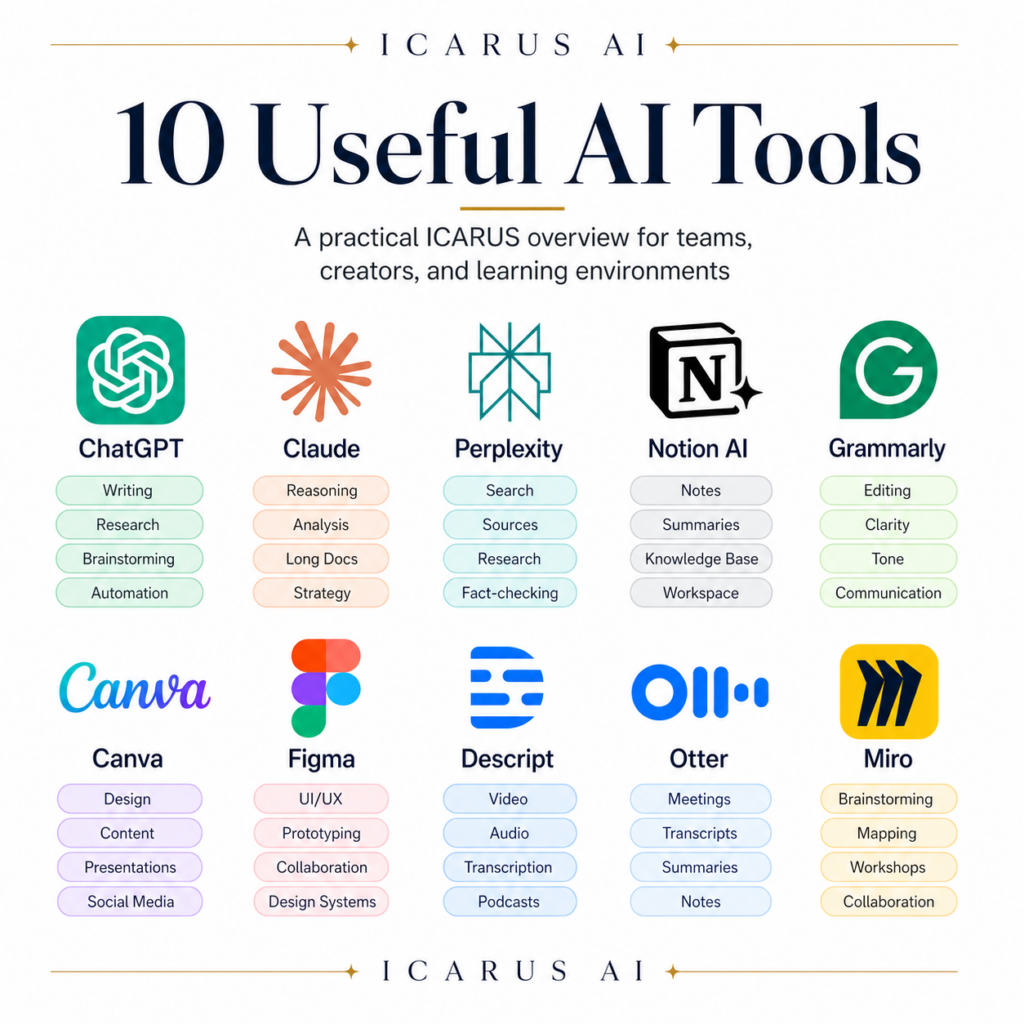
- ChatGPT — useful for drafting, synthesis, brainstorming, research assistance, and multimodal work.
- Claude — useful for long-form reasoning, document work, and structured writing workflows.
- Perplexity — useful for real-time answer retrieval and source-led research.
- Notion AI — useful for workspace search, agents, and automating repetitive knowledge tasks.
- Grammarly AI — useful for clearer writing, editing, and communication across apps.
- Canva AI — useful for fast visual creation, editable layouts, and marketing/design workflows.
- Figma AI / Figma Make — useful for accelerating design exploration, prototyping, and creative iteration.
- Descript — useful for video, podcast, transcript, and screen-content editing by editing text.
- Otter — useful for meeting transcription, summaries, searchable notes, and conversational knowledge capture.
- Miro AI — useful for collaborative ideation, workflow structure, and AI-supported team planning on shared canvases.
The most useful AI tools are not necessarily the loudest ones. They are the ones that disappear into the workflow and quietly make better work possible.
That is the shift worth paying attention to.
At ICARUS, we see AI as a process of building better systems for thought, creation, and learning.
And that is the real question organizations should be asking now:
Not “Which AI tools are trending?” But “Which AI tools are genuinely improving how we work and learn?”