

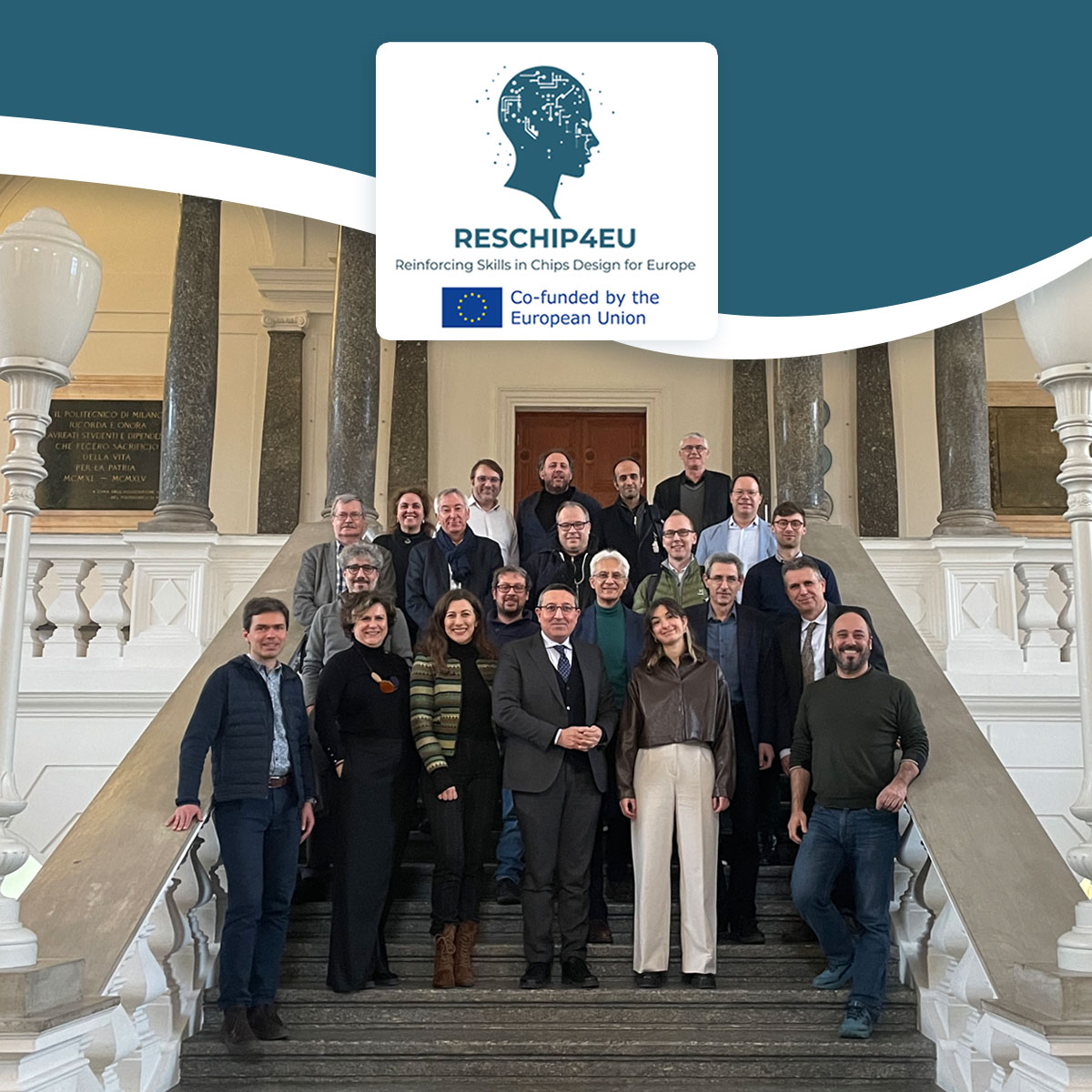
RESCHIP4EU | Consortium Meeting in Milan
📍 This week, partners of RESCHIP4EU – Reinforcing Skills in Chips Design for Europe came together in Milan for an in-person consortium meeting hosted at Polytechnic University of Milan, Campus Leonardo.
The half-day meeting provided space for:
• reflecting on project progress following the interim review
• aligning partners on priorities and implementation
• discussing next steps to ensure continued coordination across education, training, and industry engagement activities
Bringing the consortium together in person is an important part of maintaining shared understanding and momentum, especially in a project that brings together universities, industry actors, and education experts from across Europe.
Meetings like this help ensure that RESCHIP4EU remains focused on its core objective: strengthening skills in chip design, intelligent systems, and microelectronics to support Europe’s long-term digital capacity.
Meet the partners:
- 28 Digital (www.28digital.eu)
- University of Bologna (www.unibo.it)
- Budapest University of Technology and Economics (www.bme.hu)
- ISEN Méditerranée (www.yncrea-mediterranee.fr)
- Polytechnic University of Milan (www.polimi.it)
- Polytechnic University of Turin (www.polito.it)
- Tallinn University of Technology (taltech.ee)
- The University of Tampere Foundation (www.tuni.fi)
- University of Turku (www.utu.fi)
- University of Trento (www.unitn.it)
- SEMI Europe GmbH (www.semi.org/)
- Evolutionary Archetypes Consulting SL (www.ea.consulting)
- Junior Achievement Europe (www.jaeurope.org)
- STMicroelectronics ST (www.st.com)
Funding Agency: European Health and Digital Executive Agency (HaDEA)
Learn more about RESCHIP4EU: https://28digital.eu/eu-collaborations/reschip4eu
Project Number: 101158828 — RESCHIP4EU — DIGITAL-2023-SKILLS-04
Disclaimer: Co-Funded by the European Union. Views and opinions expressed are however those of the author(s) only and do not necessarily reflect those of the European Union or HADEA. Neither the European Union nor the granting authority can be held responsible for them.